
Over the past few years I’ve picked up photography as a hobby. It’s a nice creative outlet and it’s an excuse to go look at things. I dabble in photographing trains, planes and wildlife along with astrophotography. I don’t think I’m particularly good at it, but that’s not the point.
Anyways, I’m not writing today to talk about my hobbies or to show off my photos. I’m writing about how I think about photography as a physicist.
Optics
First and foremost there is optics. One of the oldest disciplines of physics, studied by Newton himself. Frankly, I don’t much care for optics. I never liked ray tracing diagrams and the thought of setting up (and carefully aligning) optics experiments brings back a whole host of unpleasant memories.
Fortunately, most of the optics is done by the very clever engineers that design your lenses. A lens will be characterized by two numbers: its effective focal length and maximum aperture. From the standpoint of a user, it’s fine to think of a 200mm camera lens as a tube with a single curved lens with a focal length of 200mm that projects an image onto a sensor at the other end.
In practice a lens like this would not be very good because it would be physically very large (approximately as long as the focal length) and not adjustable. Even simple lenses aren’t just a single piece of glass and will frequently have more than a dozen optical components inside. These serve a number of purposes, from correcting for chromatic aberration to adjusting the plane of focus and adjusting the effective focal length.
The stuff that goes into making lenses is fascinating, but it’s a whole mess of optical engineering and frankly, I don’t know much more about it.
What is a DSLR?
The DSLR I was using until very recently was a Canon Rebel T3i that first came out in early 2011. It produces beautiful photos and is, in many respects, far more capable than a brand new iPhone. There are few other digital electronics from 12 years ago that can keep up with modern devices.
DSLR stands for Digital Single Lens Reflex. Digital means that it uses a digital electronic sensor instead of film, and SLR means that when you look through the eyepiece you’re looking through the exact same optical path that will feed the sensor.

In a sense, a DSLR is a very naïve idea for making a digital camera. To first order, it’s just a film camera with an electronic sensor where the film should be and… that’s about it. Most of the other components of the camera (lenses, aperture, autofocus, shutter) are largely the same as a film camera. In fact, until you press the shutter button, the electronic sensor isn’t even on—no light is hitting the sensor because it’s all being reflected up into the viewfinder and directly into your eye.
DSLR vs. smartphone
Compare that to your phone camera, where the light is hitting the sensor all the time. You look at a screen that is basically a live video feed from the sensor. This approach has a number of advantages which boil down to this: the sensor on your smartphone collects a lot more data and processes that data in real time. My iPhone, for example, is continuously capturing a few seconds of video. When I tap the shutter, it saves 1.5 seconds before and after that as a little movie. If I missed the moment, I can even go back in time and pick a new frame from a whole second before I tapped the shutter button.
This live processing also means my phone camera can pick out faces and focus on them automatically and even do digital stabilization while I’m taking a photo, which is how you can take long exposures while holding the phone in your hand.
All of my iPhones dating back to the iPhone 5 can shoot HDR, which means each photo is really three photos with different exposure settings that the camera then combines into a single image so you can see details in shadows without the bright parts of the image being totally overexposed. To do that with my DSLR, I would have to take three exposures in RAW format and then combine them into an HDR photo later in photoshop.
Given all those advantages of having the sensor on all the time, how could a DSLR ever compete?
In a word: physics.
One advantage a DSLR has over a smartphone is sheer physics. The sensor on my iPhone 13 main camera is 35 square millimeters–smaller than the fingernail on my pinky finger. The APS-C size sensor on my DSLR is 22.3×14.9mm=332 square millimeters, more than 9 times as large as the smartphone (and “full frame” DSLRs are about twice as big again).
On top of that, large-aperture lenses mean that that sensor sees a brighter image. The iPhone 13 camera is the equivalent of a 26mm lens with an aperture of f/8.2, but the kit lens that came with my camera, when set to an equivalent field of view, has an aperture as wide as f/3.5. The actual aperture area is squared, so the iPhone is equivalent to π(26mm/8.2)2 = 32 mm2, the DSLR aperture has an area of π(18mm/3.5)2 = 83 mm2, almost 3x as large.
Photography is full of anachronisms
A fun thing about photography is that it’s full of weird anachronisms dating back to the days of film photography. For example, sensor sensitivity is measured in ISO, which are units of film speed, not anything intrinsically connected to a digital sensor. A “full frame” digital camera is one with a sensor as large as a single frame of 35mm film. Lens specifications are typically given in terms of their full frame equivalent. For example, when Apple says the iPhone 13 has a focal length of 26mm, they aren’t talking about the physical focal length of the lens, they’re saying it has a field of view equivalent to a 26mm lens on a full frame camera.
Exposure is all physics
This topic warrants its own dedicated post. Exposure settings determine how bright a photo will be by controlling the amount of light that hits the camera sensor and how sensitive the sensor is. It’s pure physics.
Shutter speed: The simplest one, how long is the shutter open in seconds. This can be anything from multiple seconds long to 1/4000th of a second.
Aperture: the aperture is a variable-size opening whose size can be adjusted to let more or less light in. Aperture is measured in units of the lens’ focal length. If the focal length is 200mm and the aperture is open 25mm, then the aperture setting would be described as 25mm = 200mm/8, thus f/8. This is a bit counterintuitive, because smaller numbers mean the aperture is larger. So f/4 would be open twice as wide as f/8.
ISO: Honestly, I don’t know what ISO stands for, but it’s effectively the “film speed” of the sensor. Higher ISO allows the sensor to make a brighter image with less light, but at a cost of increased noise. My camera has a minimum ISO of 100 followed by 200, 400, 800… all the way up to 6400.
Exposure settings are on a log scale
Brightness varies a lot in day-to-day situations. It’s easy to miss this since your eyes naturally do an excellent job of adjusting. You really notice when you have to change the settings on a camera. On a bright sunny day the light is orders of magnitude brighter than a dim room.
As a result, the exposure settings on a camera adjust on a log scale. For example, the available ISO settings typically start with 100 and double with each ‘stop’: 100, 200, 400, 800, 1600, 3200, 6400. This allows the sensitivity to vary over a massive range.

Aperture settings follow a similar logarithmic scale. On one of my manual lenses (above), the aperture stops are as follows: f/1.4 , f/2, f/2.8, f/4, f/5.6 and f/8. But wait, you say, the aperture isn’t doubling or halving with each stop: 2/1.4 is about 1.4. The key here is that the amount of light admitted by the aperture is proportional to the area of the aperture, not it’s diameter. With this in mind, we can calculate the area of the aperture of each of these settings (in the table below) and see that with each stop, the area decreases by about a factor of 1/2.
| Aperture setting | Aperture Diameter | Aperture Area |
|---|---|---|
| f/1.4 | 25 mm | 490 mm2 |
| f/2 | 17.5 mm | 240 mm2 |
| f/2.8 | 12.5 mm | 122 mm2 |
| f/4 | 8.75 mm | 60 mm2 |
| f/5.6 | 6.25 mm | 31 mm2 |
| f/8 | 4.4 mm | 15 mm2 |
All of this is really handy, because if you have your exposure all set up nicely, but realize you want a faster shutter speed, you can increase your shutter speed by one stop, and then open up your aperture by one stop, and you end up with about the same amount of light hitting the sensor.
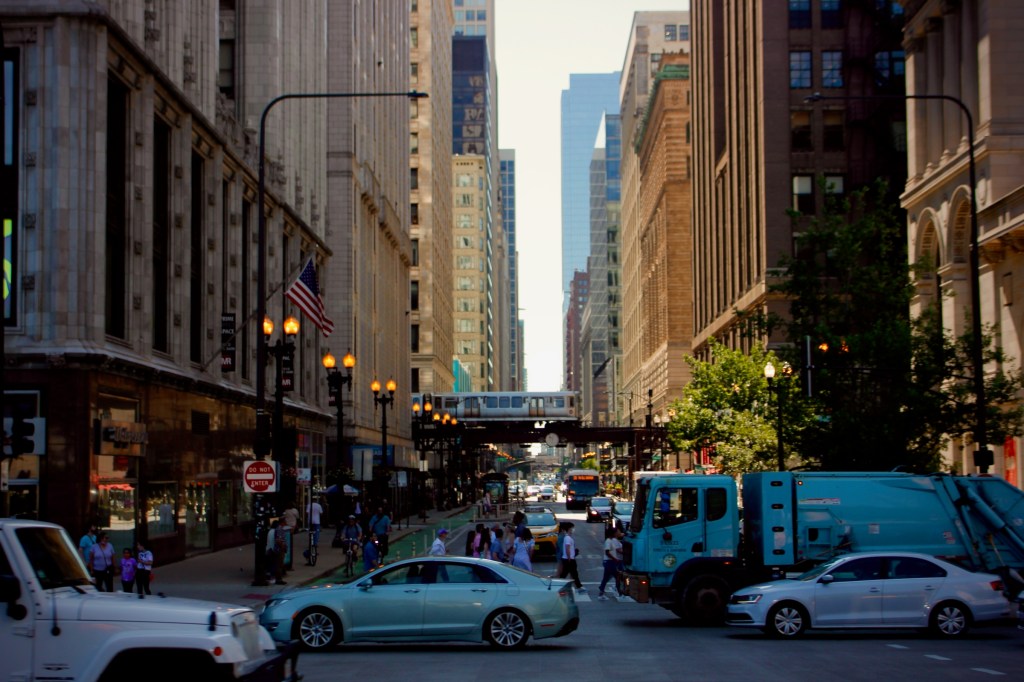
Okay I’m going to show off my photos a little bit






Coming up in part II
I’m not sure what’s coming next, but there are a few topics I think it would be fun to explore the physics of. The first is bokeh, which is the term for the blurry background. The amount of bokeh and the shape of the bokeh is determined by the aperture’s shape and size. It would also be fun to look at long exposures. Stay tuned!
 Adam Iaizzi, PhD (易亞丹)