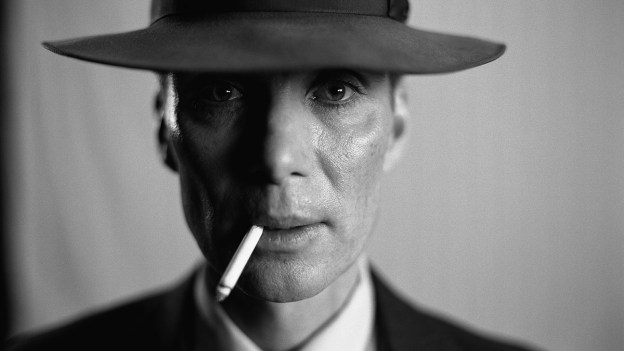
Just a few days ago I watched Christopher Nolan’s new film Oppenheimer, a biopic of J. Robert Oppenheimer, the physicist who lead the Manhattan Project and is widely known as the “father of the atomic bomb.” I loved it!
I’ve long held an interest in the history of nuclear weapons, and seeing part of this story get a big budget Hollywood movie is a real treat.
What I liked
- “Just because we built it, doesn’t mean we get to decide how it’s used.” This is an important lesson for scientists in policy: we have important expertise, but scientific considerations are not the only factors in political decision-making, nor should they be. Whatever moral qualms you might have about the decision to drop the bomb, after spending $2 billion in taxpayer money and with Americans dying in the Pacific every day, the decision on how to use the bomb could not be left up to a small cadre of unelected scientists.
- The depiction of Oppenheimer as terrible in the lab was great. As a theorist who was useless in the lab, I felt very seen.
- I love that Feynman’s only appearance was in the background as a guy playing the bongos.
- This was perhaps the most accurate depiction of the culture of physics I have seen in popular media, including the arrogance. I loved Groves’ little quip when Oppenheimer says he’s just a humble physicist: “I’ll let you know if I ever meet one of those.”
- “We have one advantage over the Nazis: antisemitism.” This really is true. The movie is shows plainly that many of the top scientists on the Manhattan project were Jews, many of them refugees from Nazi-occupied Europe. Enrico Fermi, who built the first nuclear reactor in Chicago, fled fascist Italy because his was was Jewish. Chien-Shiung Wu, a Chinese woman physicist on the Manhattan Project (and someone I’m disappointed did not make an appearance in the movie) was herself effectively a refugee from Japan’s brutal invasion of China.
- Finally, I like that they depicted Einstein as being wrong about quantum mechanics. All too often he his portrayed as an infallible genius, but his quote “God does not play dice with the universe” is an example of a time he was dead wrong. Einstein refused to believe that quantum mechanics was the fundamental truth of how the universe works.
Fun facts
There are a bunch of little things that the movie touches on that are really deserving of their own whole story. Here’s a few that I noticed:
Edward Teller — He’s a minor character in this movie, he’s the guy who is obsessed with building a hydrogen bomb before they’ve even finished the fission bomb. That’s 100% accurate. Teller was obsessed with the hydrogen bomb, and viewed Oppenheimer’s postwar opposition to it with suspicion. Ironically, Teller himself might have been one of the largest obstacles to the first successful hydrogen bomb because he spent years pushing a design that would never work. Teller was also one of the first scientists to raise the alarm of the possibility that CO2 was warming the planet, and later in life was a fierce proponent of the ill-advised ‘Star Wars’ missile defense program.
The Manhattan Project was actually not the most expensive R&D project of WWII. That honor goes to the $3b B-29 bomber project (equivalent to $49b today). The Manhattan Project cost $1.9b (~$33b today), the equivalent of less than 9 days of wartime spending. 90% of that cost was spent on refining the fissile material.
That log cabin style lodge in the movie (where they are hosting social events, etc)—that’s a real place and I have been there! The Los Alamos Ranch School was the only preexisting building on site when the lab was established. It’s now a community center.
I have a personal connection to Los Alamos. In the summer after my sophomore year of college, I attended the Los Alamos Summer School at the lab. I have few pictures of that time both because it was before the time of smartphones and because photography was prohibited at the lab.

Want to learn more?
The movie is based on the Oppenheimer biography American Prometheus, which I have not read, but there’s plenty of other great scholarship on this topic. One of the things that makes the Manhattan Project so interesting is that it was such a huge effort, and physics was, at the time, such a small field, that almost every famous physicist who was alive at the time and not in Axis occupied territory was involved.
Podcasts
First, I’ll start with an easy recommendation: The Bomb, a podcast from the BBC. The first season follows Leo Szilard, the physicist who played the biggest role in starting the British and then American bomb programs who has second thoughts. Szilard makes a brief appearance in Oppenheimer when he approaches Oppie in the DC hotel with petition from scientists who are opposed to using the bomb.
The second season of the Bomb follows Klaus Fuchs, perhaps the most accomplished spy of all time. He was a leader in the Manhattan Project, making major contributions all while passing along extensive information to the Soviets. He wasn’t caught until years later while he was head of the post-war British nuclear weapons lab. Fuchs also appears in Oppenheimer: he’s in the big inter-division meetings that General Groves was opposed to (it turns out, Groves was right about compartmentalization).
There is an excellent discussion of the ethics of the decision to drop the bomb on Hiroshima and Nagasaki in this mostly-audio Youtube video by creator Shawn. I’ll warn you that it is over two hours long, but it’s worth it.
Another great discussion along these lines can be found in Dan Carlin’s Hardcore History archive: Epiode 42 Logical Insanity. In it, Dan follows the development of strategic bombing during the war, which was initially viewed as a way to minimize casualties. It was quickly determined that there was no such thing as ‘precision bombing’ and that the only targets they could reliably destroy were entire cities. Carlin shows how bombing practices developed over time until the point that dropping atomic bombs on cities seems like a natural extension of (nightmarish) existing policies.
Books
If you want an authoritative telling of the Manhattan Project, look no further than The Making of the Atomic Bomb by Richard Rhodes. He manages to tell a complicated story about science in a way that is both nontechnical and faithful to the physics. It also reads like a novel despite being just shy of 900 pages long. (It also won a Pulitzer). The book has apparently gained a cult following among AI researchers, who fear they are about to unleash the 21st century equivalent of the bomb.
I also give my full recommendation to Rhodes followup book Dark Sun: the Making of the Hydrogen Bomb. It picks up where the previous book left off, right after the atomic bombing of Japan. As the title implies, it cover the development of the hydrogen bomb (aka ‘the Super’), closely following Edward Teller (the father of the of the hydrogen bomb), who is fiercely anticommunist and obsessed with building a fusion bomb. He’s a minor character in Oppenheimer, showing up in the Los Alamos inter-division meetings obsessed with building a fusion bomb and testifying at Oppie’s security clearance hearings near the end. There is a whole chapter in Dark Sun about the Oppenheimer hearings and the behind-the-scenes machinations of Teller and Straus to push Oppenheimer out. Dark Sun also tells the story of the Manhattan Project’s atomic spy, Klaus Fuchs, the Soviet bomb work, and the early politics of nuclear weapons, when it was still very unclear how they would be used.
If you want to learn more about the terrifying human toll of nuclear weapons, there is an excellent and very short book on the topic Hiroshima by John Hersey. I’ve written a review of it here.
Other resources
The human toll

Oppenheimer is an exciting movie, and this is a fascinating period in the history of science. It’s important in this excitement not to lose track of the human toll. Between Hiroshima and Nagasaki, as many as 226,000 people lost their lives. Far more were horrifically injured.
The survivors of the bombings, known in Japanese as Hibakusha (atomic bomb affected people) have dedicated their lives to ridding the world of nuclear weapons. While they have not yet succeeded at that goal, I believe we owe them a great debt for their role in ensuring that World War II was the only nuclear war. More reflections here.
 Adam Iaizzi, PhD (易亞丹)