
Nearing the end of a long summer day, less than an hour from sunset, a sun shower passes through. Out the window we see a remarkable sight: a double rainbow in front of a blue sky! Conditions were basically perfect: bright sun coming in at a low angle against a darkening sky. It was one of largest and brightest rainbows I’ve ever seen.
I grabbed my DSLR and started taking photos. For the first time I had taken a good photo of a rainbow (they tend not to look nearly as dramatic in photos as the look in real life).
As I was looking through the viewfinder, I thought “wow, it kind of looks like there are extra bands beyond the violet on the main arc. And the photo confirmed: there are. It turns out there is more to rainbows that I knew about.
But before we get to that those extra bands: what is a double rainbow? For that matter…
What is a rainbow?
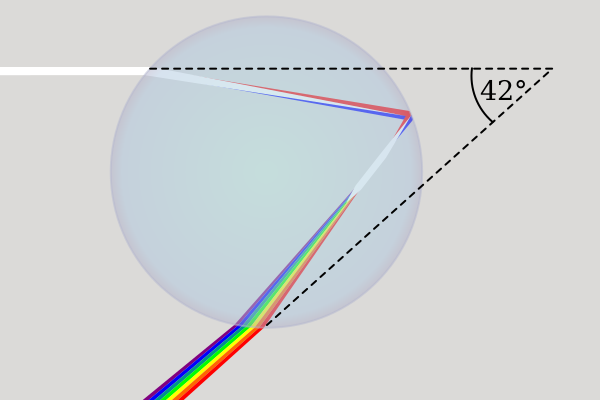
A rainbow is caused by light reflecting off the back of drops of water in the sky. As the white light from the sun enters the droplet, it bends, a result of the change of medium. In water, the speed of light is about 25% slower. The light then reflects off the back of the droplet (another change in direction) and then bends again as it leaves the droplet. As a result of all those twists and turns, the strongest reflection comes back at an angle of roughly 42 degrees to the incoming light [Wikipedia].

But wait, why don’t we just see a bright band of white light? How do the colors separate? The answer is dispersion. The speed of light in water depends on wavelength: it’s slower for shorter wavelengths. As a result, blue light bends the most and red light bends the least. If the speed of light in water did not depend on wavelength, we would just see an arc of white light with no separation of colors.
This same phenomenon, where different wavelengths of light bend by different amounts, also occurs in lenses. Photographers will be familiar with it by the name chromatic aberration. Chromatic aberration causes an artificial colored border to appear around objects in photos and it’s something lens manufacturers go to great lengths to avoid.
What is a double rainbow?
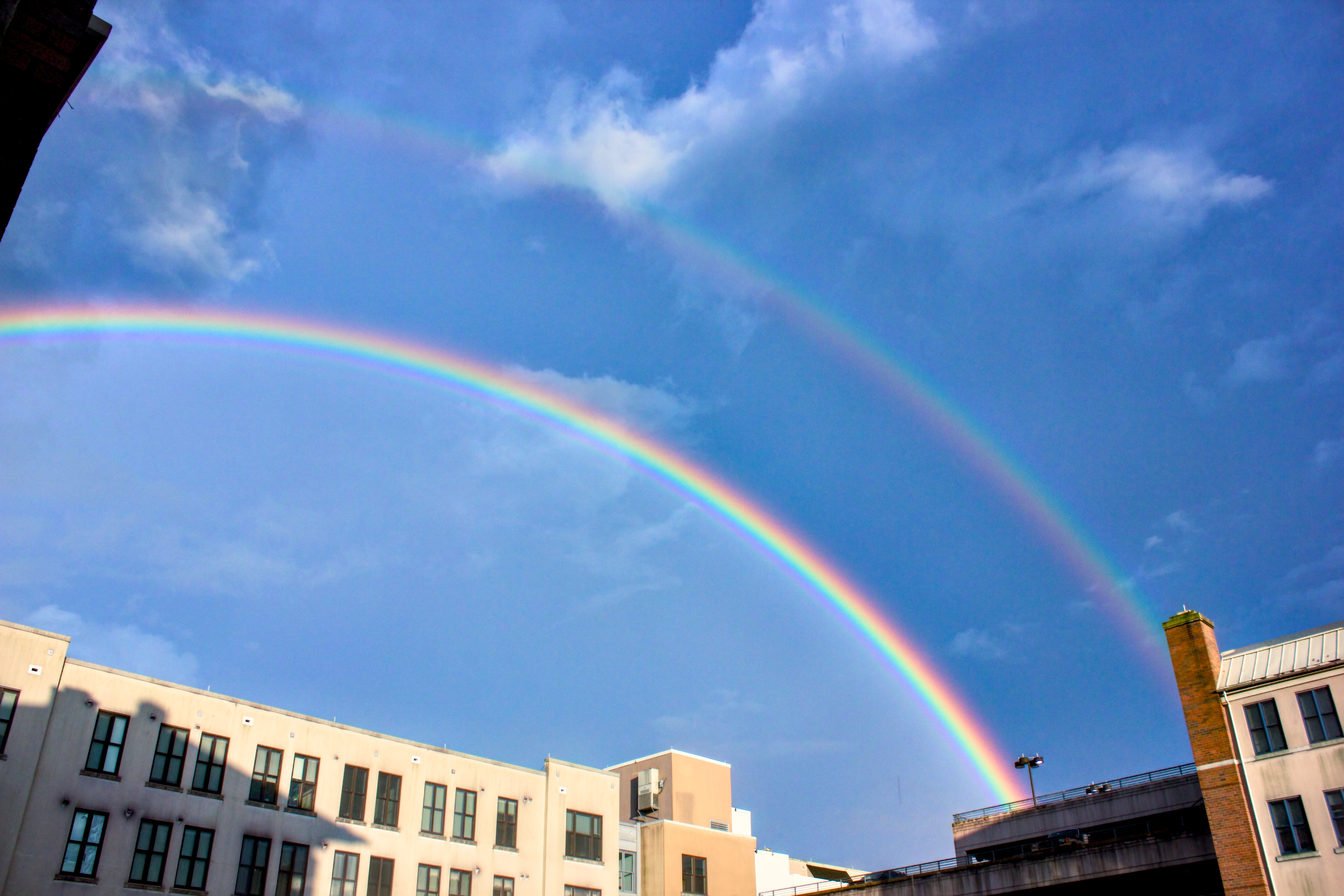
A double rainbow is caused by light that reflects twice off the back of the droplets. The second reflection cases the order of the colors to flip (red is now on the inside) and the colors are now more spread out. The secondary bow is less bright because only some of the light is reflected off the back of the droplet (the rest is transmitted). You can find an excellent description of how the secondary bow is formed on the physics stackexchange.
Supernumerary bands
Looking at the rainbow, I thought I could see extra bands beyond the violet. You can see an extra band of green, then pink, then (faintly) at least one other band of green. What are those?
My first thought was that they might be ultraviolet light. But that can’t be: our eyes can’t detect UV light. Then I thought it might be some sort of optical illusion, but here it is in the images I captured with my camera too.

It turns out these extra bands are called supernumerary bands (a rather fanciful name if you ask me).
These bands are actually a product of interference caused by light that travels along two paths with slightly different lengths. Thus, they do not have an explanation in terms of the particle model of light nor by using classical geometric optics (i.e., the ray diagrams we used to explain the primary and secondary rainbows). This explanation was first described in the scientific literature in 1804 (not a typo)!
Young, Thomas. 1804 “I. The Bakerian Lecture. Experiments and calculations relative to physical optics.” Philosophical Transactions of the Royal Society 94: 1-16.
Believe it or not, Young cites an even earlier observation, recorded on p. 243 of Volume 32 of Philosophical Transactions (dated 1723). This issue is so old that they use ‘f’ in place of ‘s’. To get the age across, here’s a picture of that article:

Of course, they couldn’t take a photograph of what they saw, so they included eyewitnesses to back them up:

Alexander’s band
One other thing you might have noticed in these photos: the sky underneath the rainbow looks much brighter than the sky above the rainbow. Once again, I was convinced this was an optical illusion until I saw the same effect in photos.

This effect is indeed real and it is called Alexander’s Band for Alexander of Aphrodisias who described the band in his commentary on Aristotle’s Meteorology [wikipedia]. I couldn’t find an explanation of this online that I really liked, but the best I found is on p. 113 of The Rainbow Bridge: Rainbows in Art, Myth, and Science by Raymond L. Lee and Alistair B. Fraser. 2001.
“All locations that are 42° from the shadow of your head are equally likely to send the concentrated rainbow light to you. Although sunlight reflected once within a raindrop is most concentrated 138° from the sun, some light is bent through all angles between 180° and 138°. Thus the sky between your head’s shadow (180° from the sun) is brighter than the sky outside the primary, making the rainbow the bright edge of a disk of light.”
So uh, hot take: rainbows are pretty cool. ∎
 Adam Iaizzi, PhD (易亞丹)