I’m really excited about the slate of events that FECS has put together for the 2023 March Meeting in Las Vegas. This includes Monday’s talk by Dr. Savannah Garmon “A trans perspective on building supportive and inclusive physics communities” and Tuesday’s FECS reception which will, for the first time since 2019, include complementary BEER. Hope to see you there!
Tomorrow (Thursday 3/18) I’m giving my talk at the March Meeting!
R20.00005: Field-induced freezing in the unfrustrated Ising antiferromagnet Thursday, March 18, 9:12 AM–9:24 AM CDT View in bulletin Watch talk live
Abstract:
We study instantaneous quenches from infinite temperature to well below Tc in the two-dimensional (2D) square lattice Ising antiferromagnet in the presence of a longitudinal external magnetic field. Under single-spin-flip Metropolis algorithm Monte Carlo dynamics, this protocol produces a pair of metastable magnetization plateaus that prevent the system from reaching the equilibrium ground state except for some special values of the field. This occurs despite the absence of intrinsic disorder or frustration. We explain the plateaus in terms of local spin configurations that are stable under the dynamics. Although the details of the plateaus depend on the update scheme, the underlying principle governing the breakdown of ergodicity is quite general and provides a broader paradigm for understanding failures of ergodicity in Monte Carlo dynamics. See also: Iaizzi, Phys. Rev. E102 032112 (2020), doi:10.1103/PhysRevE.102.032112
*Note: The views expressed here are the speaker’s, and do not necessarily represent the positions or policies of the AAAS STPF Program, the US Dept. of Energy, or the US Government.
I just stumbled across these on the internet and they are both great. These are for Keynote (on macs) but there are probably equivalent settings on Powerpoint.
1. If you want to be able to switch apps while in presentation mode (e.g. to see the Zoom window). Look at this guide on the Zoom documentation. There is also a setting where you can make your cursor visible at all times so you can use it to point at things on your slides.
The APS virtual March meeting is just around the corner! Although we are not meeting in person, FECS will spare no effort on ensuring a meeting that is as successful as before. We are hosting the following three invited sessions to highlight the contributions from early career scientists in science, industry, and international collaboration:
Scientists watch a lot of talks, and I’ve noticed a lot of people (including me) make the same handful of mistakes. Here are a few of my tips:
Number your slides. Powerpoint, Keynote and Beamer all have options to add these automatically. Visible slide numbers make it easier for people to refer back to a specific slide if they have a question, especially at the end.
Test your slides on a projector or low-resolution monitor. Computer monitor resolutions have steadily grown, but projectors technology seems stuck in 2004. This leads to a familiar trap: you make beautiful figure with graceful thin lines on your laptop, which are rendered totally invisible by the projector. Same goes for contrast, light colors like yellow are often invisible on projectors.
Keep the text to a minimum. You want people listening to you speak, not reading your slides. Use slides for short bullet points and for showing off your figures.
Even fewer equations. Unless you’re teaching a class, people are rarely going to be interested in following any mathematical derivations, and they’re hard to follow on a slide anyways. 1-2 equations per slide max. If people want to know more, they can always ask, which will probably lead to a more interesting discussion anyways.
Finally, include your contact information on the final slide. It’s easy to space out at the start of a presentation and forget to jot down the presenter’s name. Make it easier for your audience by having your name and email on the last slide along with any relevant papers you want to promote.
Disclaimer: I want to be 100% clear that these tips are not a veiled reference to anyone in particular.
After much delay, my March Meeting talk is finally online in all the right places! You can watch my talk on Virtual March Meeting or by following the link from the APS Bulletin, but I’ll also embed the video and post the slides here (PDF of slides).
As you’ve probably heard, the 2020 APS March Meeting was cancelled due to concerns over coronavirus. It was cancelled only 36 hours before it was scheduled to begin. Myself and many other scientists were already in Denver when we heard.
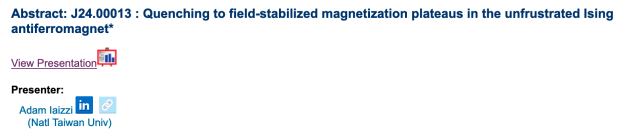
I just presented a talk“Quenching to field-stabilized magnetization plateaus in the unfrustrated Ising antiferromagnet” based on my preprint that I posted on arXiv last week at the Annual Meeting of the Physical Society of Taiwan at National Pingtung University in Pingtung, Taiwan. I haven’t gotten around to making a post about this paper yet (that is coming soon), but in the meantime I will post my slides from this talk here. My slides included some movies of the process of freezing in to magnetization plateaus. Since PDFs can’t include movies I will post the movies below.
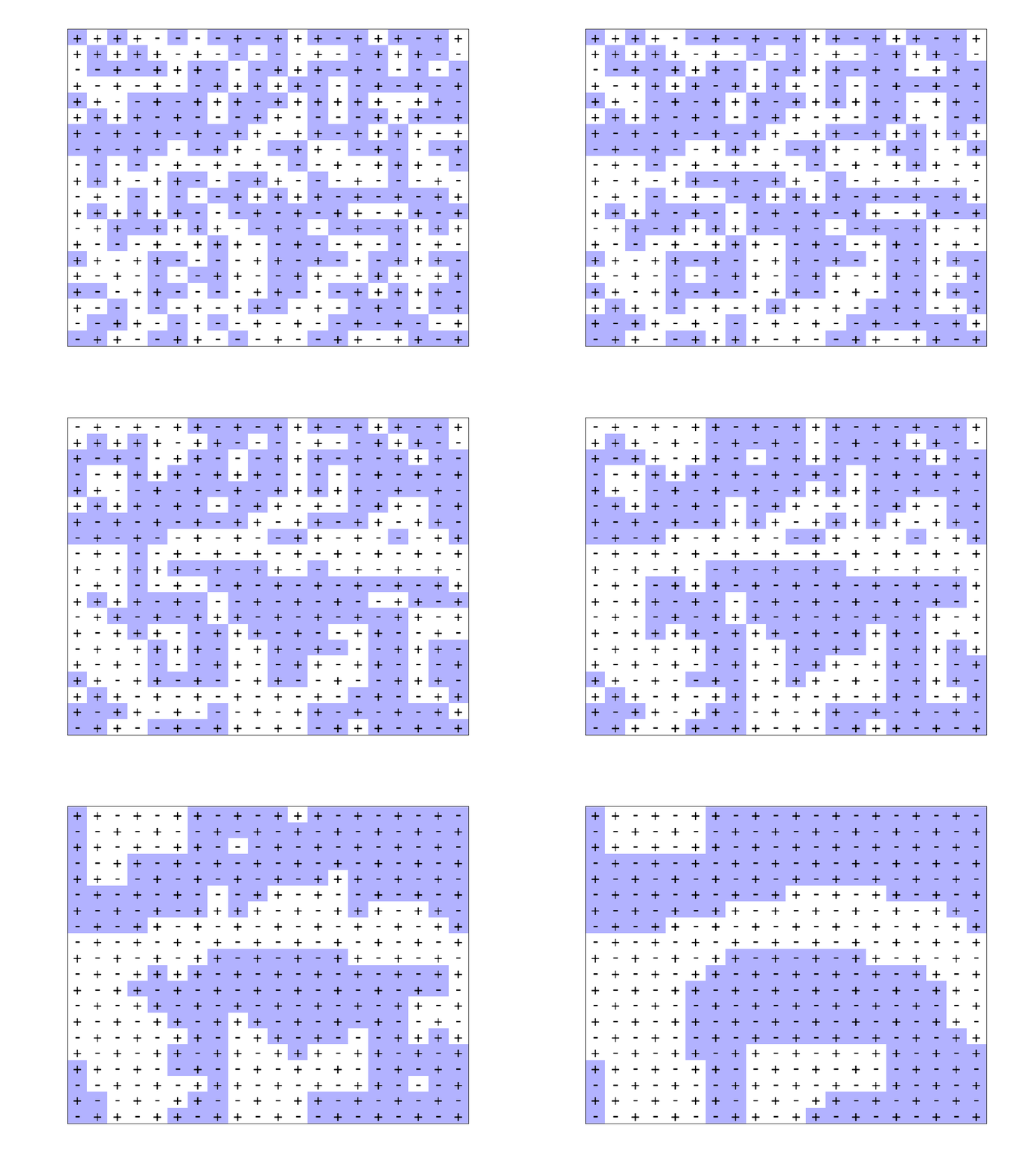
The spin configuration over time starting from a random (T=∞) state and doing single spin flip Metropolis updates at T=0 and h=1 until we arrive at a final frozen state. Individual spin states are denoted by the (+) and (-); the background shading shows which of the antiferromagnetic ground states each site is in. In the final frozen state the domain walls are all straight lines or corners with (+) on the inside.
The spin configuration over time starting from a random (T=∞) state and doing single spin flip Metropolis updates at T=0 and h=3 until we arrive at a final frozen state. Individual spin states are denoted by the (+) and (-); the background shading shows which of the antiferromagnetic ground states each site is in. In the final frozen state the domain walls are all diagonal or square-wave-like with excess (+) spin.
Rubem Mondaini was kind enough to invite to visit his group and give a seminar at the Computational Science Research Center–Beijing. My talk, “Accessing Quantum Criticality with Magnetic Field Effects: Metamagnetism and Deconfinement” covered all of my work on the J-Q model, the saturation transitions in 1D and 2D (metamagnetism and zero-scale-factor universality) up to the latest updates on my work with Harley Scammell and Oleg Sushkov studying thermodynamics of field-induced spinons at the deconfined quantum critical point in the 2D J-Q model. I got some great feedback that will help me put the finishing touches on my manuscript.
After the seminar I had chance to meet with Rubem’s students and postdocs, Chen Cheng, Sabyasachi Tarat and Can Shao and learn about the fascinating things they are working on. After that, a delicious dinner!
I didn’t remember to get a picture of me at my talk, but I did get a photo of all of us out to dinner. I hope to be back to CSRC soon!
Dinner with (from left to right) me, Can Shao, Nvsen Ma, Chen Cheng, Rubem Mondaini and Sabyasachi Tarat.
Title: Accessing Quantum Criticality with Magnetic Field Effects: Metamagnetism and Deconfinement
Abstract: Simple models of interacting quantum spins (like the Heisenberg model) are remarkable tools for understanding strong quantum fluctuations, but relatively few studies have considered the effects of external magnetic fields on these systems. I investigate the influence of magnetic fields in the J-Q model, an antiferromagnetic Heisenberg model with an added 4-spin interaction (Q). This model is known to harbor a direct, continuous phase transition between the Néel state and a valence-bond solid. This transition is believed to be an example of deconfined quantum criticality, where the excitations are exotic fractionalized particles known as spinons (S=1/2 bosons). We study the thermodynamics of the excitations and find direct evidence that they are indeed fractional. Separately, we also find that the four-spin term changes the nature of the saturation transition from “zero-scale-factor” universality to metamagnetism (magnetization jumps).
Today and tomorrow I’m visiting National Cheng Kung University (成功大學) in Tainan. I was graciously invited to give a seminar by Prof. Ching-Hao Chang (thanks!). If anyone reading this wants to chat, I’ll be visiting until Tuesday afternoon. I’m staying in the fourth-floor visitor’s office.
Title: Accessing quantum criticality with magnetic field effects: metamagnetism and deconfined quantum criticality Abstract: Simple models of interacting quantum spins (like the Heisenberg model) are remarkable tools for understanding strong quantum fluctuations, but relatively few studies have considered the effects of external magnetic fields on these systems. I investigate the influence of magnetic fields in the J-Q model, an antiferromagnetic Heisenberg model with an added 4-spin interaction (Q). This model is known to harbor a direct, continuous phase transition between the Nel state and a valence-bond solid. This transition is believed to be an example of deconfined quantum criticality, where the excitations are exotic fractionalized particles known as spinons (S=1/2 bosons). We study the thermodynamics of the excitations and find direct evidence that they are indeed fractional. Separately, we also find that the four-spin term changes the nature of the saturation transition from “zero-scale-factor” universality to metamagnetism (magnetization jumps).






 Adam Iaizzi, PhD (易亞丹)